
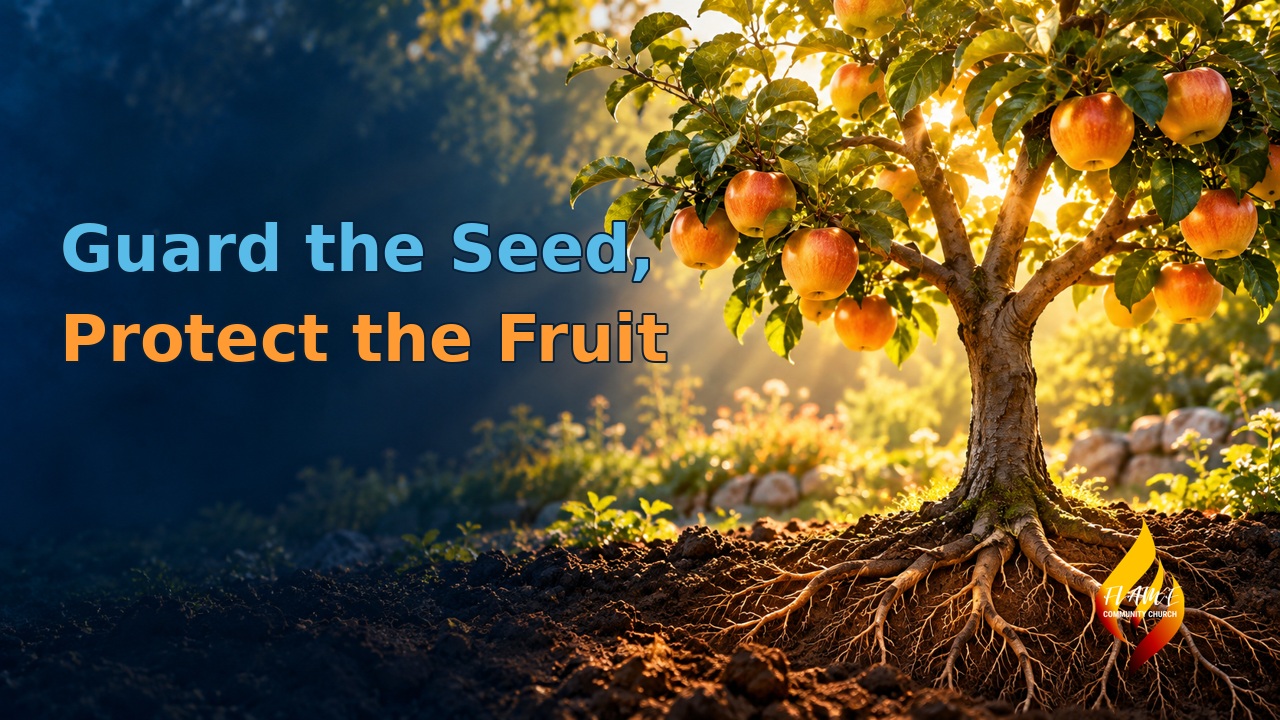
There is something almost painfully ordinary about sowing seed. You put something small into the soil, cover it, water it, and then you wait. For a while, nothing seems to be happening. And, as Andrew reminded us on Sunday, if you sow the wrong seed, no amount of enthusiasm will produce the crop you had in mind. Grass seed will keep producing grass, even if what you really wanted was a box full of wild flowers.
That picture has stayed with me because it is so easy to recognise ourselves in it. We want peace, patience and a life that looks like Jesus, but we can spend the week planting anxiety, resentment, distraction and hurried opinions. Then we are surprised by what grows. Perhaps the honest question is not only, “What fruit do I want?” but “What seed am I receiving?”
What we receive will grow
Andrew took us back to Jesus’ explanation of the sower in Mark 4. The seed is the Word of God. That matters, because Jesus is not offering us a useful idea to add to the collection. His Word carries His life. It exposes us, saves us, heals us and begins forming something new in us. But the parable also refuses to flatter us. The seed can be stolen. It can spring up quickly and then wither under pressure. It can be choked by cares, riches and other desires.
In other words, hearing is not the same as holding. I can nod on Sunday, even feel deeply moved, and still allow the Word to be crowded out by Tuesday. Don’t get me wrong: the feeling is not false. It simply needs roots. The question is what I do when the heat comes, when obedience is inconvenient, or when something louder demands my attention.
The promise of good soil
“But those that were sown on the good soil are the ones who hear the word and accept it and bear fruit, thirtyfold and sixtyfold and a hundredfold.” — Mark 4:20 (ESV)
Roots are formed under pressure
I sometimes think we interpret difficulty as evidence that we have missed God. Yet in the parable, trouble comes because of the Word. The enemy wants the seed precisely because of what it can become. Pressure does not automatically mean the seed has failed; it may be revealing where roots are still shallow.
That changes the way I look at Monday morning. The Word I heard on Sunday is not merely something to remember; it is something to practise. If Jesus has spoken about forgiveness, I let that Word reach the person I would rather avoid. If He has spoken about trust, I bring Him the worry I keep rehearsing. If He has called me to humility, I stop defending myself long enough to listen. Roots grow through repeated surrender.
This is not an argument for gritting our teeth and trying harder. The Holy Spirit waters what God has planted. Our part is to remain open, to return to what Jesus has said and to keep saying yes when the first excitement has passed. Fruitfulness is usually quieter and slower than we imagine. Seed, shoot, root, fruit. God is not in a panic about the process.
Fruit still needs guarding
Then Sunday’s message moved from predators of the seed to predators of the fruit. That is an uncomfortable turn, because it means growth does not make us untouchable. We may have seen God do something real in us and still allow pride, hatred, unforgiveness or spiritual laziness to spoil what is developing.
Pride is particularly subtle. It can take a gift God has given and quietly make it about us. It can sound like self-sufficiency: “I am fine. I do not need help. I have this.” But grace rests on the humble heart, the person who knows that every good thing comes from God and that without Jesus we can do nothing.
Unforgiveness can be quieter still. Outwardly, the fruit may look fine while resentment is working away inside it. Jesus does not ask us to pretend that hurt did not happen. He meets us in the truth of it. But because He has forgiven us at the cost of the cross, He also invites us to release judgement into His hands. Forgiveness may begin as a trembling act of obedience before it ever feels like freedom. Still, it is a way of guarding the fruit.
You see, the gospel is not simply that God gives us better gardening advice. Jesus takes the judgement our sin deserves, rises from the grave, and gives us His Spirit. He forgives us and begins making us whole. The fruit we are guarding is ultimately the life of Jesus being formed in us: love where bitterness once grew, humility where pride had taken root, and perseverance where we used to give up.
Fresh bread for today
Let me come back to that soil. We cannot live indefinitely on a word we heard months ago, any more than Israel could live on yesterday’s manna. Yesterday’s encounter with God may have been genuine, but He is inviting us to meet Him today. This is why the final movement of the devotional is so practical: gather fresh bread every day.
That does not have to mean an impressive routine. Ten unhurried minutes with Scripture can be a real beginning. Read slowly. Ask the Holy Spirit what He is showing you. Write down one response, then carry it into the day. The aim is not to tick a religious box. It is to stay close to Jesus and allow His Word to keep shaping the soil of our hearts.
A response for this week
Choose one word from Jesus that you need to receive again. Write it down, pray over it and take one obedient step. Ask Him to show you whether pride, unforgiveness or distraction is threatening the fruit.
Jesus, make my heart good soil. Let Your Word take root in me. Guard what You are growing, teach me to forgive as I have been forgiven, and give me fresh hunger for You each day. Amen.
Take the message into the week
The seed may look small, and the fruit may take time, but God’s Word is alive. So let’s receive the right seed, allow it to grow roots, and guard the fruit with humility, forgiveness and daily dependence on Jesus. What are we growing? By His grace, something that looks increasingly like Him.
You are warmly invited to join us at Flame Community Church, Cardale Street, Blackheath, West Midlands, B65 0LY. If you have questions or would value prayer, email info@theflamecc.org.uk.
You can also browse the complete Five-Day Devotionals collection.