
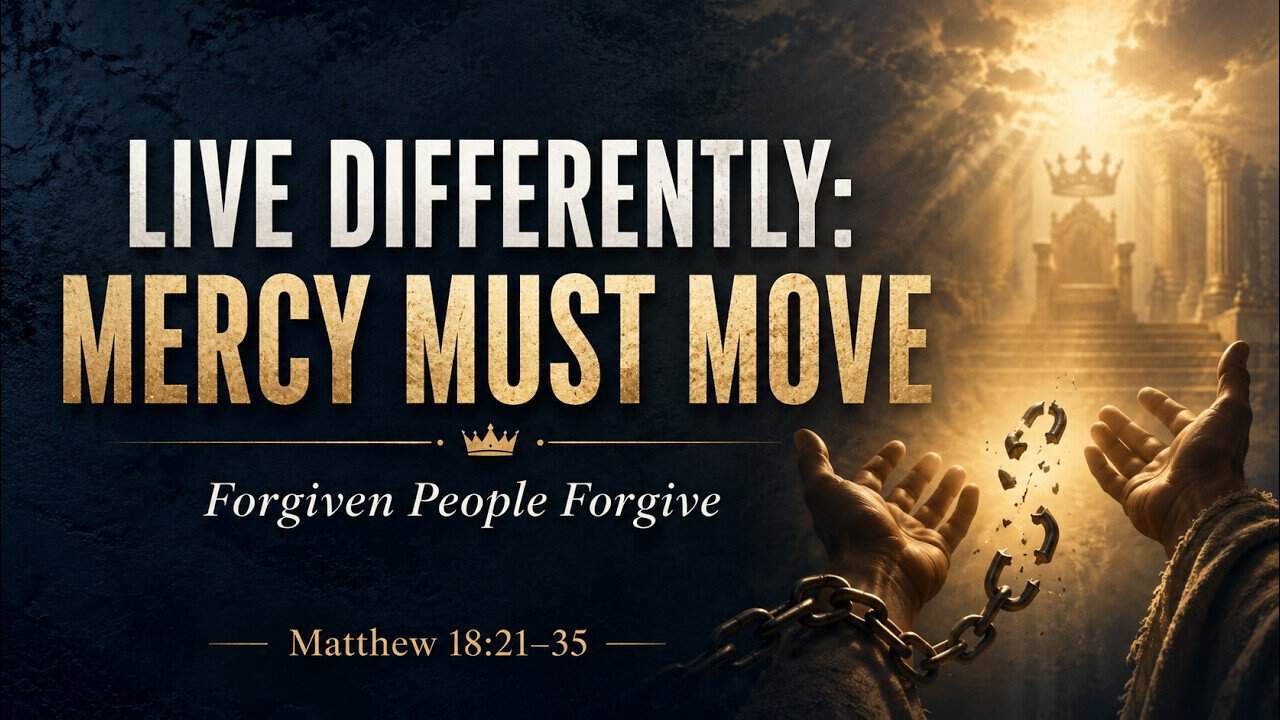
It is surprising how long we can carry a conversation after it has ended. Someone says something that hurts us, we manage to get through the moment, and then the conversation follows us home. We replay their words while making tea. We come up with the reply we wish we had given. Days later, the account is still open in our minds.
Sometimes the hurt is much deeper than an awkward conversation. Trust has been broken, and the consequences have not simply disappeared. So when Jesus speaks about forgiveness, I do not want to rush past that pain with a cheerful instruction to “move on”. In the message Live Differently: Mercy Must Move, we came to a story in Matthew 18 that takes both the mercy of God and the reality of our wounds seriously.
The question behind Peter’s question
Peter asks Jesus how many times he ought to forgive someone who sins against him. He even offers seven as a generous answer. I can understand why he wants a number. A number gives you a point at which you can close the account and say, “I have done enough.” Jesus’ answer refuses to turn mercy into a tally. If I am still carefully counting every offence, I am still keeping the ledger.
The setting matters. Just before this, Jesus has taught His disciples how to address sin within the community. He speaks about going to a person privately, bringing others if necessary, and involving the church when the matter remains unresolved. He has made room for truth and accountability. Yet in the middle of that teaching He also asks us to forgive. Accountability and mercy can belong in the same conversation.
Then Jesus tells a story about a servant who owes his king a debt beyond his ability to repay. The servant promises to pay it all back, but the promise cannot solve the problem. The king has compassion and releases him from the debt. Grace comes first. The servant has no achievement to offer and no way to work himself clear.
“And should not you have had mercy on your fellow servant, as I had mercy on you?” — Matthew 18:33 (ESV)
The question exposes the gap between the mercy the servant gladly received and the mercy he refused to give.
The second debt is real
What happens next is uncomfortable. The forgiven man meets someone who owes him far less and demands payment. The other servant begs for patience in words much like his own, but he will not listen. He has walked out of an encounter with extraordinary compassion and has immediately put his hands around somebody else’s throat.
It is easy to hear “far less” and assume the second debt did not matter. Jesus never says that. The wrong done to us may be serious. It may require a difficult conversation, proper reporting, ongoing boundaries or consequences. Forgiveness does not mean calling harm harmless, restoring trust before it is earned or returning to an unsafe situation. Those distinctions matter, especially when the hurt has been profound.
The question Jesus puts before us is harder and more personal: having received mercy for a debt I could never repay, what will I do with the genuine debt another person owes me? Will I keep looking for a way to make them pay me back? Will I keep the account alive because a part of me still wants the final word?
Giving the account to God
Forgiveness can sound as though we are being asked to abandon justice. We are not. Romans 12:19 calls us to leave vengeance in God’s hands. That means I do not have to pretend the wrong was right; I can name it truthfully and take wise action. But I can stop appointing myself the collector of a debt I cannot make good through resentment.
I know that may be easier to write than to live. A memory can return tomorrow, and with it the anger or grief we thought we had released. There is a difference between a wounded person praying, “Lord, I am struggling; help me forgive,” and someone who settles their will against Jesus and says, “I know what You command, but I refuse.” Healing can take time. Struggling towards obedience is still moving towards Him.
We need to hear the warning in Jesus’ story honestly too. He ends by speaking about forgiving from the heart. He is not asking us to recite the correct words while privately planning revenge. He calls His disciples to become people changed by the compassion they have received. Ephesians 4:32 gives the order: God has forgiven us in Christ; we are therefore to forgive one another. We do not manufacture mercy to earn His love. We receive His mercy and ask the Holy Spirit to let it change us.
What might mercy look like this week?
Perhaps it begins by admitting whose name still changes the atmosphere inside you. Perhaps you need to stop retelling an old wound to keep your anger warm. Perhaps you need help from a trusted person to put a safe boundary in place, or courage to have a truthful conversation. And perhaps your first honest prayer is simply, “Jesus, I want to want to forgive. Please begin there.”
Sunday’s message cannot stay as an interesting thought about an ancient servant. It follows us into our conversations, our homes and the way we respond when someone has genuinely hurt us. God supplies the power; His Spirit works in the heart; we respond through obedience. That is where the gospel begins to show up in ordinary life. Mercy received must become mercy released.
A response for the week
Ask the Holy Spirit to show you where you are still trying to collect a debt. Name the hurt honestly. Keep any boundary that protects you or others. Then take one real step towards releasing personal vengeance into God’s hands.
Father, thank You for the mercy I could never earn. Where I am wounded, bring healing; where I am holding tightly to resentment, help me let go. Give me wisdom to face what is wrong without becoming captive to revenge. Holy Spirit, make me more like Jesus. Amen.
If this has raised questions, or you would value someone to pray with you, you are welcome to join us at Flame Community Church, Cardale Street, Blackheath, West Midlands, B65 0LY. You can also email info@theflamecc.org.uk. There is a place for you at Flame.