
There was a school excuse in Sunday’s message about a child losing his weekly study hour when the clocks went forward. Whether anyone genuinely offered it or not, it is quite an explanation. The laughter comes easily when the excuse belongs to somebody else. It gets a little more uncomfortable when we begin listening to our own.
That is where I want to stay for a moment. Not with the most ridiculous thing we have ever heard, but with the reasonable-sounding thing we keep saying. “I would, but…” Perhaps what follows is entirely true. We are tired. We lack experience. We do not know how someone will respond. At what point, though, does an honest concern become a way of keeping God at a safe distance?
Before Moses has an answer
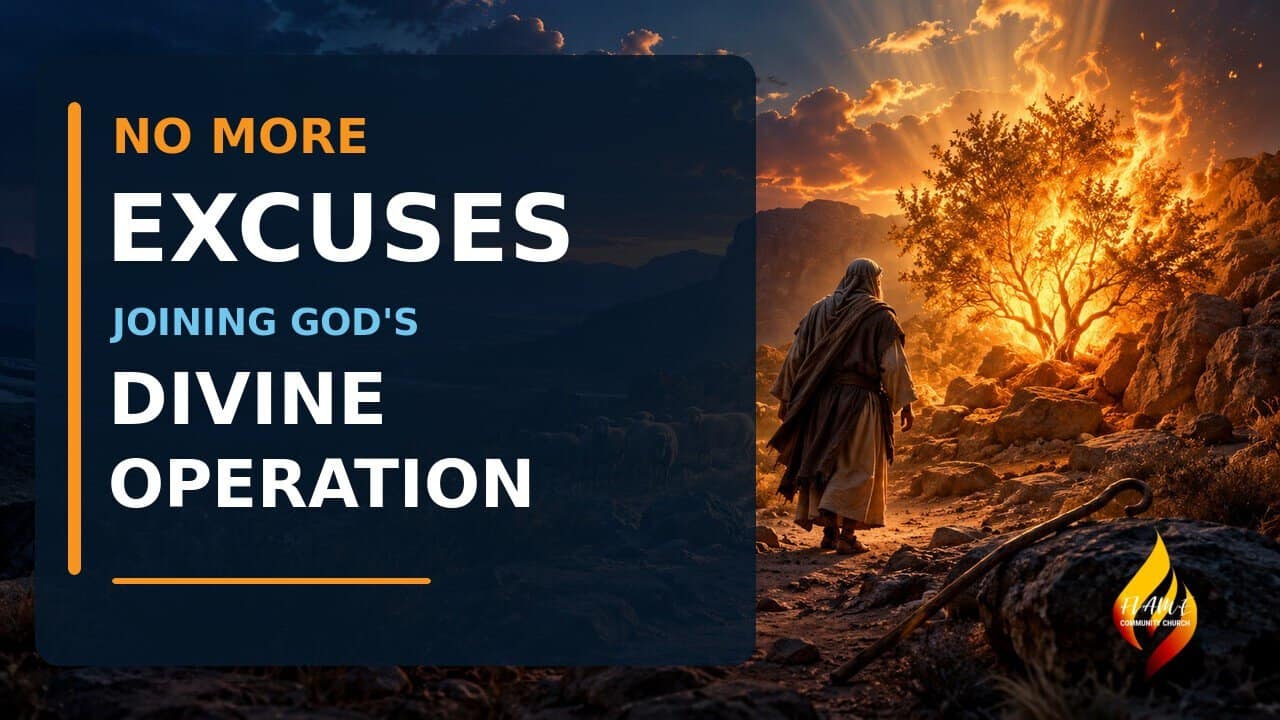
Our visiting speaker took us to Moses in Exodus 3–4. He is looking after sheep when he notices a bush burning without being consumed. God calls his name, tells him to remove his sandals and speaks about the suffering of His people. God has seen. God has heard. He has come down to rescue them. Then comes the part Moses had perhaps not been expecting: God is sending him.
It matters that we hear those things in that order. Moses does not arrive with a rescue strategy and ask God to support it. The compassion, the purpose and the initiative belong to God. As Sunday’s message put it, this is a divine operation. Moses is being invited into something God is already doing.
I think we can forget that when we talk about serving Jesus. We begin with our resources, our confidence and all the things we cannot manage. Before long, the question is whether we can produce enough strength to make anything happen. But the burning bush directs our attention somewhere else. Who is speaking? Whose people are these? Whose mission is it?
The answer is His presence
Moses asks, “Who am I?” I would be careful about criticising him too quickly. Being sent to confront Pharaoh is hardly a small assignment. There is nothing wrong with recognising that we are out of our depth. The difficulty comes when our weakness becomes the only thing we can see.
“But I will be with you” — Exodus 3:12 (ESV).
God’s answer to Moses places the weight of the calling on His presence, not on Moses’ confidence.
Notice what God does not say. He does not give Moses a flattering speech about his hidden potential. He promises to be with him. That is a different foundation altogether. Humility can lead us towards trust: “Lord, I cannot do this without You.” It can also become a respectable cover for refusal: “Lord, I cannot do this, so please stop asking.” The words sound similar. The direction of the heart is different.
Don’t get me wrong, this is not permission for church leaders to dismiss someone’s exhaustion or genuine limitations. Needing rest, support or wise counsel is not disobedience. The question is more personal than that. Am I bringing my concern to God with an open heart, or using it to close the conversation?
What is already in your hand?
Moses worries about being believed. God asks him what he is holding. A staff. Something ordinary, connected with his daily work. Yet when Moses obeys God’s instruction, that familiar object becomes part of an extraordinary sign.
We do not need to turn that into a promise that every ordinary possession will perform a miracle. But there is a searching invitation here. What have I been treating as too ordinary to offer to Jesus? An ability to listen, a practical skill, some time, a friendship? We can spend so long wishing we had somebody else’s gifts that we never surrender what is already in our hands.
Surrender comes before usefulness on our own terms. Following Jesus means that my life belongs to Him. I do not simply invite Him to improve the parts I have selected. I lay myself before Him and ask what obedience looks like here, with the people and opportunities He has actually given me.
We would quite like the whole plan
There is another part of Moses’ conversation that feels familiar. What if they do not listen? What if it goes badly? God gives him signs and promises help, but Moses is not handed a complete account of everything ahead.
I think many of us would prefer that account. We want to know the conversation will go well before we begin it. We want reassurance that obedience will not leave us feeling foolish. Yet trust cannot mean that God must first remove every uncertainty. We can be thoughtful, sensitive and prepared without being in control of the outcome.
And this brings us to Jesus. The gospel is not an invitation to become impressive enough for God to use us. Jesus died for our sins and rose again; we come to Him in repentance and faith, receiving mercy we could never earn. The risen Lord then sends His people to make disciples, promising His continuing presence in Matthew 28:18–20. We serve from belonging to Him, depending on the Holy Spirit, not trying to prove we deserved to be saved.
A willing answer, even with questions
Eventually Moses says what has been beneath the conversation: please send someone else. That is the point at which the challenge becomes difficult to avoid. God has answered his concerns, but Moses still wants another person to go.
Our five-day devotional gives us space to work through this slowly: joining what God is doing, trusting His presence, surrendering what we have, moving without every answer and responding willingly. I do not want those to remain five useful thoughts. Which one needs to become a decision this week?
A willing response this week
Bring one genuine concern to Jesus. Tell Him the truth about it, then ask for help with the next step that is already clear. You do not have to pretend you feel fearless. Begin with a willing prayer: “Here I am, Lord. Help me say yes.”
Let me come back to those excuses. The point is not to become better at spotting everybody else’s. It is to stop hiding behind our own. God is patient with our questions. Will we let His answer move us?
You would be very welcome to explore this with us at Flame Community Church, Cardale Street, Blackheath, West Midlands, B65 0LY. If you have questions or would value prayer, email info@theflamecc.org.uk. Take the reflection into your week with the complete devotional below.
You can also browse our five-day devotional collection.